|
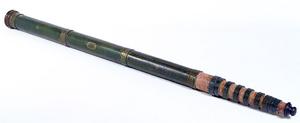
IMMS: V.51 Terrestrial telescope Maker: Giuseppe Campani Date: 1665 Place: Italian Materials: Wood, cardboard, leather Dimensions: Length c. 12000 mm Current inventory: 3185 |
| 3Back | 5Start Page |
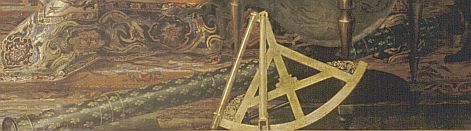
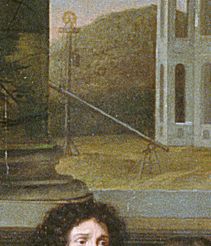 The second, longer telescope can be seen in the background just above the
head of Colbert and next to the observatory. The pole and the rope and
pulley is very reminiscent of illustrations of the observatory like the
ones shown here. I estimate it's length at 15-20 feet.
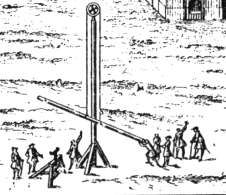
The second, longer telescope can be seen in the background just above the
head of Colbert and next to the observatory. The pole and the rope and
pulley is very reminiscent of illustrations of the observatory like the
ones shown here. I estimate it's length at 15-20 feet.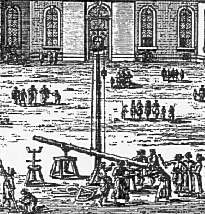
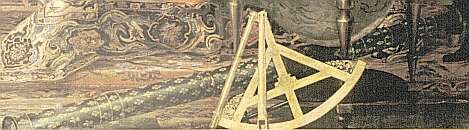
Notice the various similar features: green leather exterior, covered with gilt, the presence of emblematic ornaments.Large terrestrial telescope consisting of ten wooden tubes covered with cardboard. The largest is additionally covered with green leather with gilt tooling and the Medici coat of arms. It houses the wooden mount for the objective lens. The other tubes are covered with red marbled paper. The smallest contains the compound eyepiece. The objective lens V.6 and the compound eyepiece V.7 belong to this telescope. The compound eyepiece inserted in the telescope carries the inscription "lente meno acuta" ["less acute (i.e., less powerful) lens"]. The tube in which it slides has two inscriptions: "Per la lente più acuta" ["for the more acute lens"] and "Lente meno acuta" ["(for) the less acute lens"]. The magnification is 223 or 112, depending on the eyepiece. Toward the mid-1660s, Giuseppe Campani built a telescope of 52 palms (11.6 m) that—in a paragone degli occhiali [one of several telescope competitions]—proved superior to one made by Eustachio Divini. In 1665, Campani presented another instrument of the same length to Grand Duke Ferdinand II de' Medici, which is the instrument here described. On July 11, 1665, the Grand Duke observed Jupiter and its moons.
IMMS: V.51 Terrestrial telescope
Maker: Giuseppe Campani
Date: 1665
Place: Italian
Materials: Wood, cardboard, leather
Dimensions: Length c. 12000 mm
Current inventory: 3185
“In fact, during a trip to the Provence in November 1672, an impatient Cassini personally went to the Marseille customs office to pick up a telescope that — with his customary skill — Campani had constructed for him; Cassini described it as “une excellente Lunette de 35 pieds” [“an excellent 35-foot telescope”](approx, 11.4m).”The 35-foot being equal to about 11.4 meters points to Cassini using French 'feet' (35*32.48cm=1136.8cm). Huygens' 36-feet suggest Rijnlandse voeten as unit of measurement (36*31.4cm=1130.4cm). which seems in line with the fact that the letters mentioned above were written to his brothers Lodewijk and Constantijn.